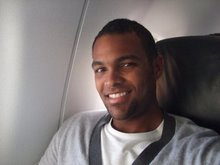
Y'all wasn't exactly expectin' a pitcher a'Mammy, wuzya?
Eighty years ago this week, Monroe, Louisiana-based Delta Air Lines began serving Atlanta Airport with one daily nonstop to Birmingham. From that skimpy hop over the state line, Delta has developed ATL into the world's largest airline hub, with nonstop flights to over 80 international destinations and who-knows-how-many domestic cities (well, Wikipedia probably knows, but...). In fact, it's because of Delta that whether you're going to Heaven or Hell, you'll have to change planes at ATL.
A large part of the reason I like Delta (theoretically, anyway) is because of its commitment to Atlanta, a Southern city that, for all its faults, has always been much more progressive than the region to which it belongs, no doubt a positive consequence of its connections to the rest of the world. Likewise, Southern culture gets exported as well, from the unrefined graciousness of the cleaning ladies in the terminal to the gleam of the TSA agent's gold tooth—my home culture, for better or worse. Oh, and there's also that Chick-fil-A in Concourse A.
You can read more about Delta and the A at the airline's blog. Meanwhile, in honor of Delta's 80th anniversary at the doubly-named Hartsfield-Jackson Atlanta International Airport, I leave you with Atlanna's own OutKast and their Southern Gothic classic, "Ms. Jackson," probably filmed right down US-19 from the airpert itself. For real.
Fly Brother welcomes your views. If this post hit the spot, please comment and/or click.
Afro-Belgian musical group Zap Mama has effused pan-African rhythm and flow for the last 20 years, badooing and doowapping on politics and partying in English, French, and Bantu. Started by the striking Congolese-born, Belgian-bred Marie Daulne, and using their voices as musical instruments, the all-lady ensemble carries you from London to Lyon to Lagos with a mix of traditional West African rhythms and their diasporic progeny: soul, reggae, funk, jazz, salsa, and house. I've recently rediscovered them on my iPod, so I thought I'd share.
Fly Brother welcomes your views. If this post hit the spot, please comment and/or click.
Today, I return to São Paulo, my favorite megacity, for a weekend of sophistication and debauchery. Brazil's largest city presents me with ample opportunities to sate every aspect of my being. I love her for that. The four videos below juxtapose images of the world's largest underrated city from its adolescent growth spurt to its mammoth adulthood and accompanying developmental issues:
São Paulo, 1943: This propaganda-soaked documentary, produced by the US government in 1943 (when Sampa's population was a mere 1.3 million), highlights the seeds of industrial development that have served as a blessing and a curse for São Paulo. Despite the film being skewed towards an upper-class, light-skinned Brazil, it's still fun to see images of the bustling old downtown districts (my favorite parts of the city) in their heyday.
São Paulo 1954: This short film, with unfortunate sound editing (the rockem-sockem instrumental score should have been used to punctuate the footage of traffic and movement, not static skyscrapers), conveys the sense of emerging power and importance of the nascent metropolis.
São Paulo 2008: Featuring the modern metropole of 20 million that I know and love, this short film captures the vibrant realities of SP, good, bad, and ugly. Chaotic, inspirational, tough, profound, crowded, progressive, imposing, impressive, endless.
São Paulo 2009: Part of a National Geographic multi-part series on megacities, this 45-minute documentary features the green revolution taking place in São Paulo and the aspirations to sustainability as good business for Brazil's financial capital.
Fly Brother welcomes your views. If this post hit the spot, please comment and/or click.
Inaugurated in 1960 as Brazil's brand-spanking-new capital, Brasília was built on a high, semi-arid plateau in the mid-western region of the country to bring money and people into the vast and empty interior. The city has certainly filled-out since these images were filmed, but it's interesting to see life in my retro-futuristic home base during its first few years of existence.
Mostly what you see are government buildings and dormitory-style apartment blocks, punctuated by the twin towers of Congress, with the curved concrete spires of the unfinished cathedral shown toward the end. The soil here is the same red "Jawjah" clay many of us Southerners know well, though the film was recorded in the dry season (it's crazy wet these days, so the city's very much green), and you can see why Brasília's a bitch for pedestrians. Government salaries were tripled to get people to move with their families from the old capital, Rio, and there's a definite difference in dress and appearance between the stylish denizens of the new city proper and those at the bus terminal who came from other regions of the country to help build the place, but had to live in the poorer, far-flung satellite cities of the Federal District.
And it's not boring, folks. Really.
Fly Brother welcomes your views. If this post hit the spot, please comment and/or click.
San Francisco's black population has declined from 13% in 1970 to 7% today. Micah sees himself as less than one-in-ten; Joanne sees herself as just one. Medicine for Melancholy explores love, race, and, to my mind, America's most beautiful city.
Living outside of New York, it's easy to miss entertaining, insightful, and even inspirational stage plays. Thanks to Spike Lee, the entertaining, insightful, and inspirational Passing Strange was filmed on its very last Broadway performance in 2008, capturing an amazing theatrical experience in an appropriate medium for temporal and spacial export beyond the Great White Way. The semi-autobiographical, gospel/pop/rock-infused story of a black, middle-class, angst-ridden teenager who jets off to Europe in search of "The (ever elusive) Real" in the early 80s was brought to my attention by a college buddy of mine, himself casting off the binds of a nine-to-five to pursue artistic endeavors; he said he immediately thought of me and suggested I order the DVD. He explained his understanding of the show in a series of text messages:
[Passing Strange encompasses]...searching for the real more as a metaphor rather...ur purpose...the reason y u live and breathe...and the reason y ure here. Yes...this can apply to racial identity and culture but i thought it as something deeper than that. Defining your soul...devoid of culture or race. Him trveling and visiting different cultures trying to find where he fits is on the surface...but underneath it all laid something universal...regardless of upbringing...background...or race...the search for truth and the journey for inner peace. This can be applied to anyone...the person hopping from job to job trying to figure out what he or she needs to do in life to be happy...the person hopping from religion to religion to find the truth...or the truth that satisfies him or gives him peace...the chick hopping from man to man trying to fill the void that'll finally make her feel complete...etc.
To me the play hit on so many levels...so many artistic levels and the struggle that artists grapple with on a daily basis...established artists and up and comers trying to find their spot...their niche. Brilliant.
Need I say more? Watch this clip from The View, in which the supporting cast welcomes the protagonist to Amsterdam and "The Real," then order the DVD and fly.
Fly Brother welcomes your views. If this post hit the spot, please comment and/or click.
Carnival, the annual celebration of debauchery preceding 40 days of disciplined abstinence leading up to Easter, is in full swing and last year, I posted tips on how to become part of the party. Well, if you can't make it this year, or you'd like to see how things go down in Brazil before you go down, you can catch live streaming video of the six-day bombastic madness in Salvador da Bahia, and the blinding glitz of the two-day samba competitions in Rio and São Paulo (yes, they have Carnival there, too):
Jam with Radio Raheem-sized sound systems day and night in Salvador, from this afternoon through Tuesday night.
It's that time of year again where folks in Latin America, Louisiana, and the Mediterranean are prepping for Carnival, which starts next week in most places. In Brazil, the Carnival Muse competition is underway, where judges select a winner from among representatives of each samba school to open the Rio Carnival parade. Unfortunately, it's one of the few times Brazil's darker sisters appear on national television. Fortunately, it's hot.
(If you have no patience for Portuguese, you can skip the interviews and catch the dancing in the last 45 seconds of the video.)
Back when I was in Cairo a few months ago, I had taken a taxi into the Old City to catch a free performance of the Whirling Dervishes (in Turkey, which has higher-profile dervishes, they charge admission). As soon as I got out of the cab near the market, a loquacious peddler named Ahmed approached me and asked me if I needed some help finding something. I told him I was looking for the Dervishes and he said he'd show me where they perform. We walked into the market, down a bustling and colorful alley, to a cathedral-like structure where the show would start in another hour. He invited me to see his papyrus shop to kill time, promising that I had no obligation to buy. What the hell? (By the way, papyrus is the ancient precursor to paper, a writing surface made from the dried reeds of the papyrus plant that grows along the Nile).
Mohamed and Ahmed
After climbing up fluorescent-lit concrete stairwell, with nary an inclination as to any malice on Ahmed's part (either I'm especially sensitive to the underlying goodness of people or I'm a damn gullible fool), I entered the secluded, second-floor gallery. There stood Mohamed, Ahmed's Nigerian business partner, who spoke to me about the Egyptian art of papyrus painting. Despite the quesionable location of the shop, Mohamed came off as an expert in his vocation, Ahmed shining equally as a consummate salesman ("Your mother is best mother in the world after my mother, she deserve something from the gallery"). I bought a beautiful $25 papyrus scroll for my mom, but I also got some interesting footage of Mohamed describing the art and craft of papyrus painting.
When you're in Cairo, make sure you say "hi" to Ahmed and Mohamed (and buy something, too):
Alghouri Papyrus Art Centre 28 Ahmam El Mosbagha St. (beside Wokela Sultan) Alghouri, Al Azhar, Cairo, Egypt Tel. 2512-5859, Cell 0106695899 www.alghouriartcentre.com
Fly Brother welcomes your views. If this post hit the spot, please comment and/or click.
Cruising around Miami for New Years in a rental car with no iPod dock meant much radio time. Thankfully, 93.9 (in spite of random and agonizing bursts of "I Gotta Feeling," "Dancing Queen," "Single Ladies," and "I Will Survive") took it back to 1980s Dade County, when no ethnic community was a true majority, South Beach was still gritty and vice-ridden, and everybody punched it down 95 South to locally-produced freestyle and bass music*. Here's some of Miami's finest (plus a little Crockett and Tubbs action) to carry you from MIA across Biscayne Bay:
NEW YORK— Yeah, there are rats, service disruptions, drunken old men, drunken young women, and the pungent odor of pee, but dammit, the New York City subway runs 24/7. And I mean the whole system, not just a couple of train lines here or there. In the city that never sleeps (an oft-quoted untruth), the 24-hour bars and 24-hour diners and 24-hour pharmacies and 24-hour gyms and 24-hour Apple Store remain connected by underground rail. The late night trains that stop at each station don't convey the same warp-speed urgency of the express trains that race underneath the grid of Manhattan at ten blocks a minute, but the lower number of riders means available seats and fewer obstacles when rushing through the maze-like transfer stations.
There's also the loopier entertainment; at midnight, you not only get the drummers and the guitarists and accordion players, you get to see punchy folks getting jiggy like this in the subway:
On a bottom-lit dancefloor the size of a small hotel lobby, black-white-and-Latin b-boys, Asian ballet dancers, 40ish couples from Spanish Harlem, 50ish couples from Harlem Harlem, Korean-American salsa instructors, A&R execs, mailroom gofers, baldies, dreadheads, girls-with-girls, guys-with-guys, professional dancers, occasional two-steppers, Southerners, Northerners, foreigners, and a middle-aged woman with a cane all samba'd, salsa'd, and shook assorted and voluptuous body parts in the spirit of the way the truth the light the drum.
What might have been an underground incarnation of the nearby United Nations headquarters jammed to an intoxicating, almost religious confection of Diasporic rhythms tracing the triangle from Banjul to Buenos Aires to the Bronx and back, conjured up by musical sorcerer Nickodemus and supplemented by live percussion. As soon as mi gente's hips got used to swiveling, feet got called into glorious church-stomping candences, arms enlisted in jazzy flourishes, and heads involved in breakneck floor spins. Continuous smiles shifted from toothy and excited grins to coy, Mona Lisa-style expressions of contentment that body and beat worked in unison. Couples formed and broke apart, partners shifting among the crowd of one-time strangers who at once recognized each other as disciples of the music. There was no pretense, no posturing, no being too cute or hard or proud to nod, smile, or give a thumbs-up. Of all the people in New York, it's the house heads who embody the ideas of borderlessness, of universality, of humanity in celebration of diversity and ignorant of demographics, all the while charging and being charged by the eternally pulsing heartbeat of enchained masses ferried across the Atlantic centuries ago.
London tries, but this happens no where else but New York.
Here's a little shadow-dancing footage for those of you who couldn't make it to the event. You can't see much, but you can feel it. Sorry I couldn't film more...I was too busy gettin' my own groove on.
Today, I head up to the Frozen North: ten days in New York City (any lurkers in the area, get at me). In honor of the occasion, I'm going to share with you a song that I think speaks more to The City I usually encounter than does Jay-Z and Alicia's new cut, Madonna's homage, or even Old Blue Eyes' standard paean (though I think "Sidewalks of New York" might come close :-) Anybody know this one?
On a related note, I read recently that one should to verbalize one's dreams as a part of manifesting them into reality. That being said, I shall verbalize that, within five years, I plan to be living seven-to-eight months of each year in São Paulo and three-to-four months of each year in New York (the summer months, of course; what could be better?), with each transition bookended by a few weeks of travel. The question isn't "why?" (I mean...why not?). The question is "how?"
On an unrelated note, I came across this song in my iPod recently. If electronic music is supposed to be danceable and joy-inducing, then why does this one make me so sad? :-(
Fly Brother welcomes your views. If this post hit the spot, please comment and/or click.
Oh, Hong Kong! How the currents of history and culture have conspired to make you the entoxicating urban assemblage that you are. Poised at the foot of Victoria Peak and gracing both shores of a similarly-named harbor, Hong Kong has lost none of her shine after having changed hands from the British colonial power that created her to the Chinese superpower that is her cultural foundation. Expats from all over the English-speaking world keep the financial sector abuzz, hold-up in luxury skybox apartments and tooling around packed and narrow streets in Maybachs and Bentleys (only the service people—accountants, attorneys and such—whip around in Beemers and S-Classes). The masses, and I do mean masses, aspire to these trappings, though, for the time being, whisking around the city in speedy, efficient public tranport doesn't make being part of the proletariat seem so bad. Hong Kong is a city of conspicuous consumption and unbridled capitalism, upward mobility writ large. But unlike, say, Dubai or Las Vegas, she's been handling her business for centuries.
And that's what makes her somewhat imposing. Arriving by ferry into Victoria Harbour, guarded on both sides by walls of skyscrapers, themselves backed-up by mountain peaks, I felt as if I'd just entered a fortified medieval city with high walls and turrets full of sentries. Once inside, the cluttered and exhilirating commercial alleys of Kowloon City or Sheung Wan contrasted with the sleek and chic straightaways of TST and Causeway Bay, and regardless of the cost of rent, a pair of shoes, or a bowl of soup in any given area, the place was crowded, teeming, jammed, packed, populated. Literally, erybody and they mama lives in Hong Kong.
Despite a population density of 15 thousand people per square mile, I didn't find HKers to be particularly outgoing. Unlike other places I'd been, in spite of looking conspicuously foreign, I barely got a second glance from anyone. This in itself didn't bother me. I was annoyed, however, by the few blacks I did come across, and I mean few and far between, who actually looked away as we approached one another on the street. I was aghast; never in my travels had I not crossed paths with a fellow black Westerner (usually distinguishable from black Africans by carriage, demeanor, and hairstyle) and not shared the bruh-man headnod of solidarity and kinship in a foreign land. Well, it was straight "incognegro" in Hong Kong*. Maybe the brothers and sisters thought I was Indian, as there were many in HK, but it was the whites who I was continually greeted by at intersections and on the street. I was hurt to my heart. I was angry.
Fortunately, I had been blessed with a few soulmates in the city who could feel my pain: the lovely and talented Nikita the Traveller kept me company when not parsing French grammar for the kiddies at school; and Victor, novice diplomat and expert translator (homeboy be tawkin' dat Chinese!) who graciously provided a roof, vittles, and wireless Internet for a week in Wan Chai, as well as a crew of fellow FSOs who knew where to go in Hong Kong for the hot beats and hot grits (yes, grits). We were of split opinion regarding the eye-avoidance issue: Victor saying folk greeted him all the time (I say that's because of his dreads), while Nikita parked in my lot, highlighting numerous instances of shade. That aside, Victor and his friends provided me with much insight into life as a diplomat (though, to be fair, HK ain't exactly Kabul or Ciudad Juarez, so I think they might be just a tad biased, understandably), and almost sold me on the idea, until we compared the three-month annual vacation time afforded teachers versus the fourteen days they get in the Foreign Service. You do the math.
When I wasn't hanging with the homies, I hoofed it around the city, wiping the sweat off my brow while snapping photos of open-air meat and flea markets in Wan Chai, wading through the throngs in Times Square, expanding my mind at the Hong Kong Museum of History, politely declining an offer of tailor-made suits by Pakistani salesmen on Nathan Road, flying over to the Big Buddha on the longest cable-car ride in life, zooming up to breathtaking Victoria Peak on the near-vertical tram, coursing back and forth across the harbor on the Star Ferry, uncovering the lone capoeira class in town, and scouting out the nearest Burger King to ease a craving I'd had for the last month.
Hong Kong is hot. I just wonder why the people are so cold.
*Side note: Subsequently, in both Macau and Seoul, brothers greeted me appropriately; one was from Mozambique and the other Canadian. This vindicates Asia as a whole and isolates HK as a mecca for coloreds with no damn home trainin'.
Check the photos:
Then ride with me to the roof of Hong Kong in the glass elevator of the Hopewell Centre:
Dry and monstrously big, India's capital city houses over twelve million people who, despite sprawling over 570 square miles at the apex of the Indo-Gangetic plain, still seem stacked on top of one another. The New Delhi train depot served as my introduction to the city and my most uncomfortable experience in India: thousands of people milling around the dusty platforms, spitting phlegm despite signs discouraging the practice (hello H1N1/SARS/bird flu/regular flu!), kids running around in tiny t-shirts and no underwear, pulverized fecal matter rising with the clouds of dust as trains pulled into the station. I was afraid to lick my lips. At the station, I was conspicuously foreign, which for me is unsettling in chaotic environments like this, and I was stared at more than at any time on my journey. One guy came up to me with a gob of amber wax at the end of a stick and offered to clean my ears for me. I responded in Spanish, and he retreated with a grin that said, "What the hell is this muhfuka speaking?"
Unlike Mumbai, where I stayed with a friend I already knew who doubled as a translator and had easy access to transportation, Delhi meant the renewed adventure of traveling solo. And while I met many interesting people and had numerous profound conversations via that friend, it's always when I'm alone that I meet the most surprising people. North India was not short on surprises. In fact, during my five days there, I met:
Willy and Ula, an inspiring middle-aged German couple I met on the train from Delhi to Agra. With their grown children off raising families, Willy and Ula had already trekked through Latin America for a month with rudimentary Spanish before traipsing off to India with rudimentary English. They had been taken advantage of by the staff of their hotel and were trying to cope with thickly-accented Indian English by the time we met. I decided to ask if my CouchSurfing host could help them once we got to Agra. It turned out to be the best decision I could make.
Rajat, a no-limit soldier stationed at one of the many military installations in heavily-fortified Agra. Soft-spoken and sharp-featured, he commanded respect from his on-base inferiors to the off-base touts and rickshaw drivers swarming around us at the station. He met us with the names and phone numbers of a couple hotels in town and before taking me back to his place to grab a shower (this was post-14-hour train ride from Mumbai), he made sure Willy and Ula were safely tucked away in a hotel and that we had decently-priced transport to the Taj Mahal and Agra Fort the next day. The consummate CouchSurfing host, Rajat introduced me to Tulsi Mulethi tea and the Hindu tenet of present-focused living. 'Preciate ya, brother.
Jag, the film and television director who grew up in Australia to Indian parents and brought her cross-cultural perspective back from Oz. Our paths crossed at another CouchSurfer's house in Delhi and I knew we'd be hanging hard once I saw her large eyes and wide smile. We got our grub on at a frou-frou restaurant on Delhi's periphery, then our club on at a crowded nightspot a few barrios over. It was just a day in Delhi, but memorable nonetheless.
Tino and Tony, dance instructors imported from abroad to establish the Indian National Ballet who happened to be crashing one floor down in my central Delhi guesthouse. Tino, a hip-hop and jazz teacher from the Canary Islands who spoke English with a British accent and black American idioms, sat pulling his hair out over a girl in Mumbai who had turned him out. Tony, a fellow Southerner, whipped up some slammin' gumbo and garlic pasta using recipes he had learned from his ex-wife. Tino and I sat and sulked (in Spanish) in their apartment because it was Diwali—the biggest Hindu holiday—and salsa night had been cancelled. Family holidays always suck when you're on vacation.
I was honored to have this diverse group of miscreants and ne'er-do-wells cross my path. It's the type of interaction that makes traveling alone worthwhile; I'd never have met any of them had I been rolling with one of my peeps. And I'd be six friends short.
See Delhi here:
And watch the Magic Carpet Maker waterproof one of India's famous rugs at the carpet factory in Agra. Sorry about the sideways video, folks. Just turn ya head. ;) Magic Carpet Maker from Fly Brother on Vimeo.
Fly Brother welcomes your views. If this post hit the spot, please comment and/or click.
Today, I'm taking my last transoceanic flight of the RTW, leaving Kuala Lumpur at midnight and arriving in Los Angeles at 10am, via eight hours in Seoul. Total travel time: 25 hours. Because of a hook-up, I'm in business class. But watching this commercial, Korean Air even makes their economy service seem appealing:
Then, there's this enticing ad for their Seoul-Los Angeles-São Paulo service. Tell me you won't wanna be on the next flight down:
Fly Brother welcomes your views. If this post hit the spot, please comment and/or click.
In India, there's often just too much traffic for an American-style SUV to go barrelling through the streets of Mumbai or Delhi. So, they've motorized an Asian transport icon, the rickshaw: originally a two-wheeled wagon pulled by a runner to move the social elite from one place to another without having to exert themselves. Over time, the runners stopped running and started pedaling, pulling the cart on a modified bicycle, as seen in this photo from gridlocked Karol Bagh, New Delhi. Cheaper than cabs, but certainly more convenient than buses, modern ricks rip and run throughout North Mumbai (they're not allowed in Town because of the chaos they'd cause), seemingly squeezing into whatever places, roach-like, the driver can fit the front wheel. Their hand-eye coordination and faith in bus and truck braking systems is phenomenal.
Steamy and sensual, a masala of disparate peoples, faiths, and tongues facing the Arabian Sea, Mumbai (still called Bombay by many of its residents) sprawls in languid grandeur like a vine-covered statue of Lakshmi in repose. At once chaotic and laid-back, the city dons the role of its most famous monument as the Gateway of India, riding astraddle its identity as wholly Indian with imported British sensibilities, place names like Chowpatty and Marine Lines only superficially reflecting this duality. If Mumbai's punctual, if crowded, commuter train lines were more like New York's subway system, I'd say I spent most of my time trundling the Number 1, between grungy Downtown, simply called “Town” and studded with oxidized colonial jewels such as the Chhatrapati Shivaji Maharaj Vastu Sangrahalaya (formerly “Prince of Wales Museum”) and the imposing Victoria Terminus (also, like the airport and aforementioned museum, named for ancient ruler Chhatrapati Shivaji), and Uptown, a mix of close-in residential suburbs bustling with upscale-to-low-end commercial strips and anchored by the heavily Christian colony of Bandra, where I stayed with friends of Protestant religious affiliation, Goan ancestry, and Portuguese nomenclature.
After a weak Monsoon, resulting in imposed water cuts to the more impoverished areas of the city, the heavens decided to make up for lost time and dump large quantities of precipitation over the country for four days straight; in southern India, hundreds of people were killed and over a million displaced as flood waters washed away their homes. Luckily, I stayed dry in the luxury of my friends' large concrete home; millions of others, of course, live in make-shift lean-tos along the many waterways and railroad tracks coursing through the city. I will say, however, that the shocking thing about India's poverty that I glimpsed only briefly in Mumbai, wasn't the degree of poverty—there was nothing I hadn't seen after four years of living in and traveling around Latin America—but the magnitude, caused only by sheer overpopulation. And while I am aware of the horrifying child deformity, elucidated in the controversial Slumdog Millionaire (which features a protagonist who, my friends say acidly, speaks English not as if he learned it from touting tourists at the Taj Mahal as suggested, but by having his knuckles rapped more than a few times for mispronunciation by a proper Catholic Mrs. Krabapple), other poverty-stricken burgs, like Rio de Janeiro with its astronomical crime rate and accompanying off-duty police brutality, have their own location-specific monsters to slay. I'm not saying, “See...India's not the only place with problems!” I'm saying that India's poverty is the most exoticized, as if the subcontinent is more of a lost cause than any other potential power (though some might say that with nuclear ambitions and plans to build a harbor statue bigger than Lady Liberty, our girl India might want to re-examine her priorities).
While I wouldn't say that Mumbai has the worst traffic I've ever seen in a major developing-world metropolis, I would say that it has the loudest I've ever experienced, with incessant high-decible horn honking despite government campaigns encouraging a quieter commute. But that Indian attachment to noise also stems from being a country delightfully smothered in sound: from the cawing of scary crows in the trees to the festive shouts of delivery boys (grown men, really) in Crawford Market to the bangalangalanga of Punjabi percussion and orgiastic hip-and-neck-popping Bollywood production numbers to hip-hop with DJ Candy at Zenzi—don't nobody know music like Indians know music!
Then there's the food, slammin' spicy cuisine with innumerable stews and rice dishes with a whole lotta names I can barely pronounce (plus okra) that tastes like somebody's Louisiana grandma put her foot in it (a Southern phrase for those who don't know). And the discourse: at birthday parties and in rickshaw rides, I became engaged in conversations about not just Obama, but black feminism and The Color Purple, spanking as essential to child-rearing, disgust at the continued availability of Pond's White Beauty cream and its perpetuation of self-hatred, and heated debate over non-violent Ghandi-style protest against oppression versus a more by-any-means-necessary approach (up for a spirited Martin v. Malcolm convo, anyone?). I'm starting to think that Indians are just black folk with straighter hair.
Indeed, even here, I was taken as a son of the subcontinent. Folks looked at me all funny when I didn't speak a word of Hindi. They said I could easily be from Goa, the former Portuguese stronghold in the South where more than a little mixing took place between colonizer and colonized. I can't seem to get the Indian head wiggle down, though. To see what I mean, check the bobble of my girl Adèle at the end of this video from Crawford Market on a random Thursday night in the heart of “Town,” then enjoy the photos of my stint in the largest city of a country of 1,150,000,000 people. Thems a lotta zeros.
Fly Brother tackles international travel in unabridged, unapologetic, full and complete color. It's also the blog name of writer and educator Ernest White II, a tall, ruggedly handsome, erudite, occasionally delusional Black American male living in Brazil's largest city.

 Y'all wasn't exactly expectin' a pitcher a'Mammy, wuzya?
 A large part of the reason I like Delta (theoretically, anyway) is because of its commitment to Atlanta, a Southern city that, for all its faults, has always been much more progressive than the region to which it belongs, no doubt a positive consequence of its connections to the rest of the world. Likewise, Southern culture gets exported as well, from the unrefined graciousness of the cleaning ladies in the terminal to the gleam of the TSA agent's gold tooth—my home culture, for better or worse. Oh, and there's also that Chick-fil-A in Concourse A.
 .
.


 Posts
Posts